Sachin Kumar S
Engineering Leaders
Most organizations approach AI implementation tactically, building one-off solutions for specific problems. This may work for proof-of-concept projects, but it creates unsustainable technical debt as AI adoption grows. Teams inevitably end up duplicating data, writing redundant code, and struggling to maintain consistency across projects.
How can enterprises scale AI deployment without creating chaos, duplicating data, or locking themselves into a single vendor?
A Recent Parallel
The current situation mirrors the days of cloud hosting before AWS, Azure, and Google Cloud. Back then, every team had to manage its own servers, networking, and security, distracting them from their product development work.
Cloud platforms solved this by handling the infrastructure, so product teams could focus on building applications instead of managing data centers.
Enterprise AI is at a similar inflection point, and it requires a similar solution: By building a comprehensive AI development platform, enterprises can enable their product teams to innovate confidently, quickly, and securely without rebuilding infrastructure for each new use case. This approach establishes foundational rules once and applies them across all products, teams, and data sources.
Six Critical Requirements
An effective enterprise AI platform should meet six critical requirements:
- Integrate multiple AI models. No single LLM excels at every task. Your platform should support OpenAI, Claude, Gemini, and emerging models, allowing teams to choose the right tool for each specific use case.
- Access data without duplication. The platform should allow AI to query data where it already lives: internal databases, file repositories, Intranet sites, external APIs, public websites, and more. This ensures fresh, authoritative information and a single source of truth.
- Enforce existing governance rules. Your data governance policies shouldn’t change just because you’re adding AI. A responsible approach means inheriting existing authentication, authorization, and lineage rules.
- Provide robust security. Security isn’t just about stopping unauthorized access; it’s equally important to prevent inadvertent disclosures by well-meaning employees. This means setting rules around what files users can upload or download, blocking transmission of secret keys and credentials, and enforcing data handling policies.
- Control LLM token costs. AI can get expensive fast. The platform needs built-in monitoring and controls to prevent runaway costs while keeping teams productive.
- Enable easy administration. If only specialists can manage the platform, you haven’t solved the scaling problem. Centralized integration and administration should be straightforward, allowing the AI team to focus on infrastructure rather than individual applications.
Sample Platform Architecture
Here’s one way to structure an enterprise AI platform using current technologies:
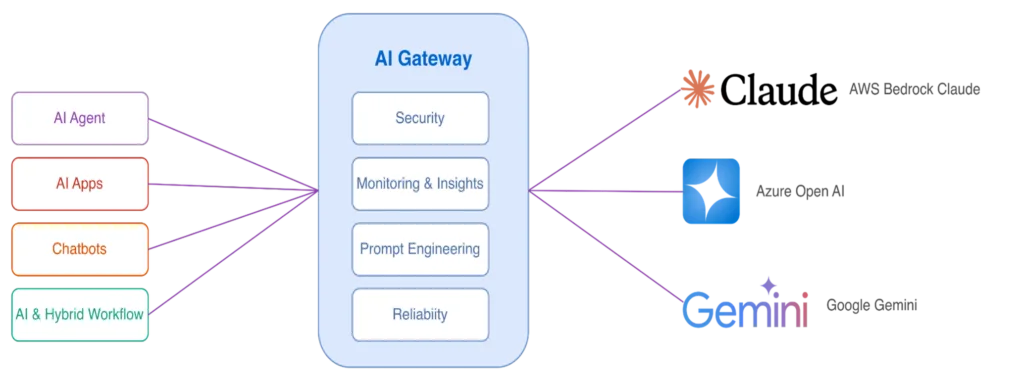
AI Gateway
A unified interface abstracting multiple LLM providers handles authentication, rate limiting, request routing, and failover across providers. Teams can switch between OpenAI, Claude, Gemini, and emerging models without changing application code. The gateway also controls what data leaves your organization, such as blocking sensitive patterns like API keys, credit card numbers, or personally identifiable information.
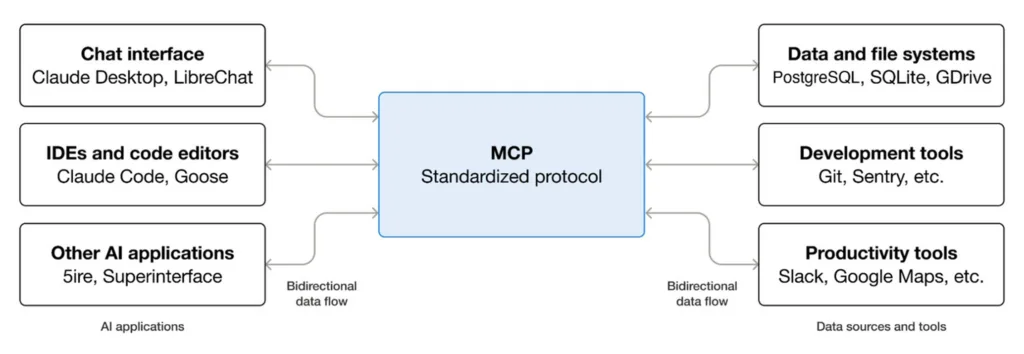
Model Context Protocol (MCP)
An open standard for connecting AI to data sources. MCP provides consistent access to databases, file systems, SharePoint, internal wikis, external APIs, and public websites, regardless of format or location. MCP servers enforce existing data governance through fine-grained access controls, evaluating each request against security policies before returning authorized information.
How It Works in Practice
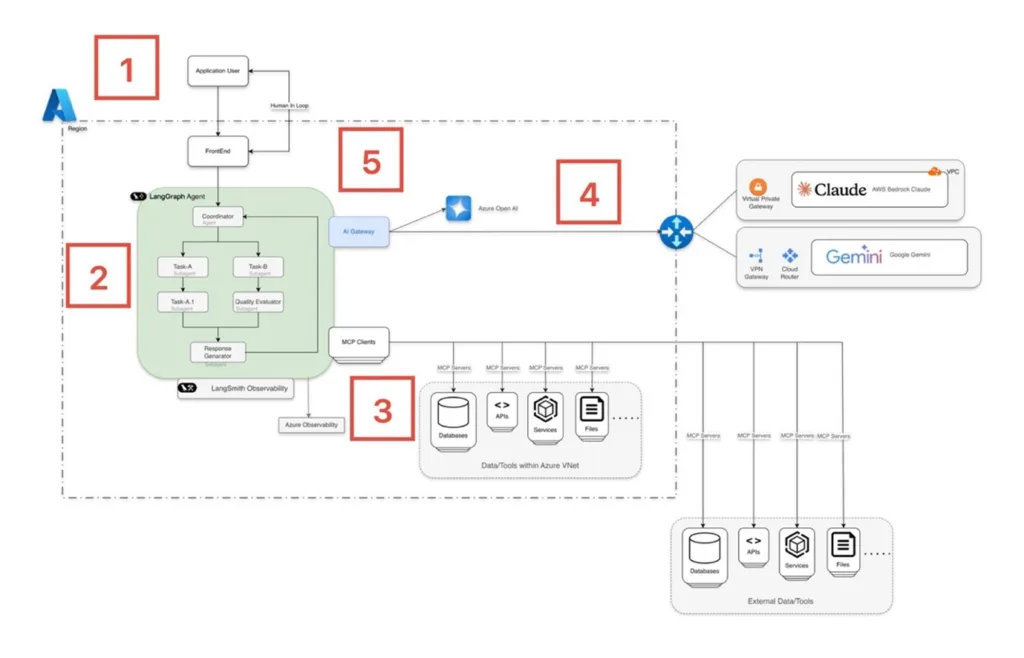
Here’s a typical workflow showing how these components work together:
- User enters a prompt.A user enters a prompt into your application’s UI,perhaps asking to analyze sales trends or generate a customer report.
- AI agent routes the request.A customized AI agent evaluates the prompt and routes it to the correct destination based on the request type and available resources.
- MCP servers gather data.The MCP serversidentify which data sources are needed, e.g., internal databases, file repositories, SharePoint sites, external APIs, or public websites. Each source system evaluates access permissions, ensuring the requester is authorized, then retrieves only the necessary information.
- AI gateway selects the model.The AI gateway receives the enriched context andforwards it to the most appropriate LLM based on the task requirements and cost constraints, such as Claude for analysis, OpenAI for creative tasks, or Gemini for specialized queries.
- Agent returns response.The AI agent receives the LLM response and returns the synthesized answer to the user.
Because this uses open standards, you can swap components as better options emerge: Replace your AI Gateway without touching applications, or swap MCP implementations without breaking integrations.
Why Open Standards Matter
Cloud providers will eventually offer enterprise AI platforms as native services. These services are probably one or two years away; Amazon, Microsoft, and Google are already moving in this direction. When they do, they’ll adopt open standards like MCP rather than creating proprietary alternatives.
By building on open standards today, you can lift and shift to cloud-native solutions when they mature, retain flexibility to integrate new tools as they emerge, and avoid rebuilding your entire platform when better options appear.
Think of early Kubernetes adoption. Before cloud providers offered managed Kubernetes services, many organizations built their own container orchestration capabilities. Once managed services were available, those organizations that were using standard Kubernetes patterns migrated easily, while those using proprietary solutions faced expensive rewrites.
The Strategic Advantage
Organizations that implement this AI platform approach using open standards gain several immediate advantages:
- Development teams can ship AI features faster because they’re not building infrastructure from scratch each time.
- Data remains secure and fresh because it never leaves its source systems, maintaining a single source of truth across all AI applications.
- Costs stay predictable thanks to centralized monitoring and controls.
By embracing a flexible platform and open standards, you can innovate and transform easily. As new LLMs emerge or existing ones improve, you can incorporate them through your AI gateway without touching application code. When regulations change or security requirements evolve, you can update the responsible AI governance policies once rather than patching dozens of separate implementations. When managed cloud AI services appear, you can migrate to them.
Above all, by offering a robust, secure, and scalable AI platform, your product teams can focus on what they do best.